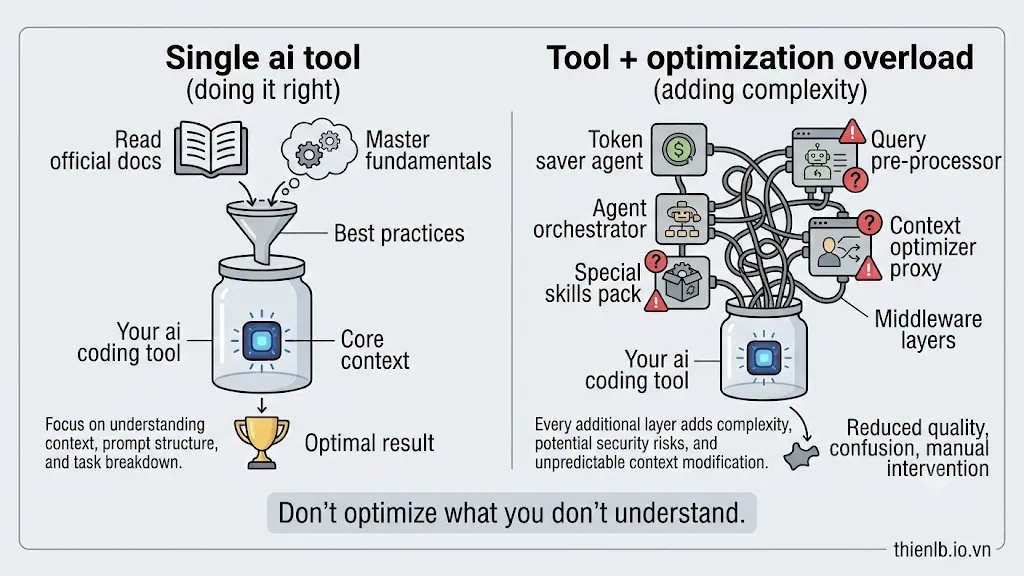
Recently, I’ve seen more and more tools and open-source projects claiming they can reduce token usage by 60–90% when using AI coding tools. That made me wonder: do we really need all these extra layers on top of our AI coding tools?
AI coding tools like Claude Code, Codex, and Cursor already provide detailed guidance on how to use them efficiently. Each tool has its own approach to managing context, reducing unnecessary token usage, and optimizing the overall workflow. So what happens when we add another layer on top — a wrapper, context optimizer, proxy, middleware, or some other tool that tries to modify how the AI coding tool works?
I’m not saying these tools are bad. In fact, I think experimenting with them can be valuable. But I think we should ask a few questions before blindly installing them.
If a tool claims to save 60–90% of tokens, where does that number come from? Is it backed by a proper benchmark? And more importantly: does saving tokens affect the quality of the result?
When someone does run the benchmark, the answer isn’t always the advertised one. JetBrains tested one of these tools across 86 tasks in paired A/B trials: the bill came out 7.6% higher at low reasoning effort, and unchanged at high effort. The tool’s own counter still reported millions of tokens saved.
Reducing token usage is relatively easy if you simply remove context. The harder question is whether the AI still has the right context to solve the problem correctly. If you save 50% of your tokens but the AI needs more iterations, makes more mistakes, misses important context, or requires more manual intervention, did you actually save anything?
There is also another concern: security. Every additional layer means another component sitting between you and your AI coding tool, and that component may have access to your source code, prompts, context, files, or other sensitive information. Do you really understand what it is doing? Do you trust how it handles your data? And have you actually evaluated it?
Look at it from another perspective
AI coding tools are built by large teams of engineers who are very aware of the cost of inference. Token usage is not just a technical problem — it’s a business problem. If a company can significantly reduce token usage while maintaining the same quality, they have a strong incentive to do it themselves.
Of course, that doesn’t mean we should blindly trust every decision made by these tools. No tool is perfect. But before trying to optimize a system, I think we should first learn how to use the system correctly.
If you’re just getting started
If you’re new to AI coding tools, I don’t think your first step should be installing five different layers to reduce token usage. Start with the fundamentals: read the official documentation, understand how the tool manages context, learn how to structure your prompts, learn how to break down tasks, understand when to start a fresh context, and learn how to provide the right information at the right time.
And most importantly, follow the best practices recommended by the tool itself. Claude Code, Codex, Cursor, and other AI coding tools are constantly evolving, so their official documentation is usually the best place to start.
Once you understand the fundamentals, then experiment. Build your own layer, try an open-source project, benchmark it, measure the results. Maybe you’ll discover a better way to use the tool. I strongly encourage that kind of exploration.
But there is a principle I try to follow:
Don’t optimize what you don’t understand.
Don’t install things you don’t understand. Don’t immediately trust a claim that says “save 90% of your tokens” without looking at how that number was measured. And don’t measure token usage alone — look at quality, correctness, latency, cost, and task completion rate as well.
Because the goal isn’t to use the fewest tokens possible. The goal is to get the best result with a reasonable amount of resources.
Do it right first. Optimize it later.